Energy, the final frontier
It was never about the algorithm. The Second Bounce of the Ball, Part 4: why cheap electrons, not models, decide who wins the AI era.

The AI race is real. But the race beneath the surface — the one that actually determines the winners — is a fight for cheap electrons.
And we’ve been here before.
This morning, OpenAI paused its $31bn Stargate UK project. Not because the models don’t work. Not because there’s no demand.
Because electricity in Britain is too expensive.
So the company that kicked off the current AI goldrush, backed by hundreds of billions in committed capital, looked at a G7 economy with world-class universities and talent and said: the power bills don’t work. We’ll come back when the energy is cheaper.

Here we have the thesis of this whole series, playing out in real time.
We’ve spent three years talking about AI as a software problem.
Tyler Cowen asked Sam Altman what single resource he’d want more of to scale compute. Altman didn’t say talent. Didn’t say chips. He said: electrons.
Energy is the binding constraint. Compute just converts it into something.
▶ Watch the video in the original post on Substack
“Why don’t we just make more GPUs?” Cowen asked. “Because we need more electrons,” Altman replied.
Altman has also said, with a straight face, that a “significant fraction” of Earth’s total electricity should eventually run AI.
Nikolai Kardashev proposed measuring civilisational advancement by energy consumption.
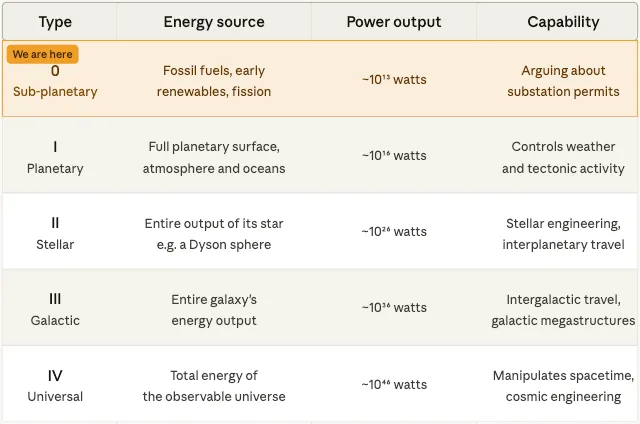
A Type I civilisation harnesses its entire planet’s energy output. A Type II its star. We are in Zone 0 arguing about planning permission for substations while trying to build artificial general intelligence.
Every new AI model generation needs roughly ten times more compute than the last. That compute runs on power. Cheap, reliable, dispatchable power is not uniformly distributed.
We have been here before at least twice during the long boom of this industrial revolution.
The map of the industrial revolution was the map of the coalfields (example 1)
In the early 1700s, Newcastle had the highest ratio of labour costs to energy costs in the world. Not because wages were low. Because coal was extraordinarily cheap. British seams sat close to the surface. Iron ore was nearby. Rivers could carry it.
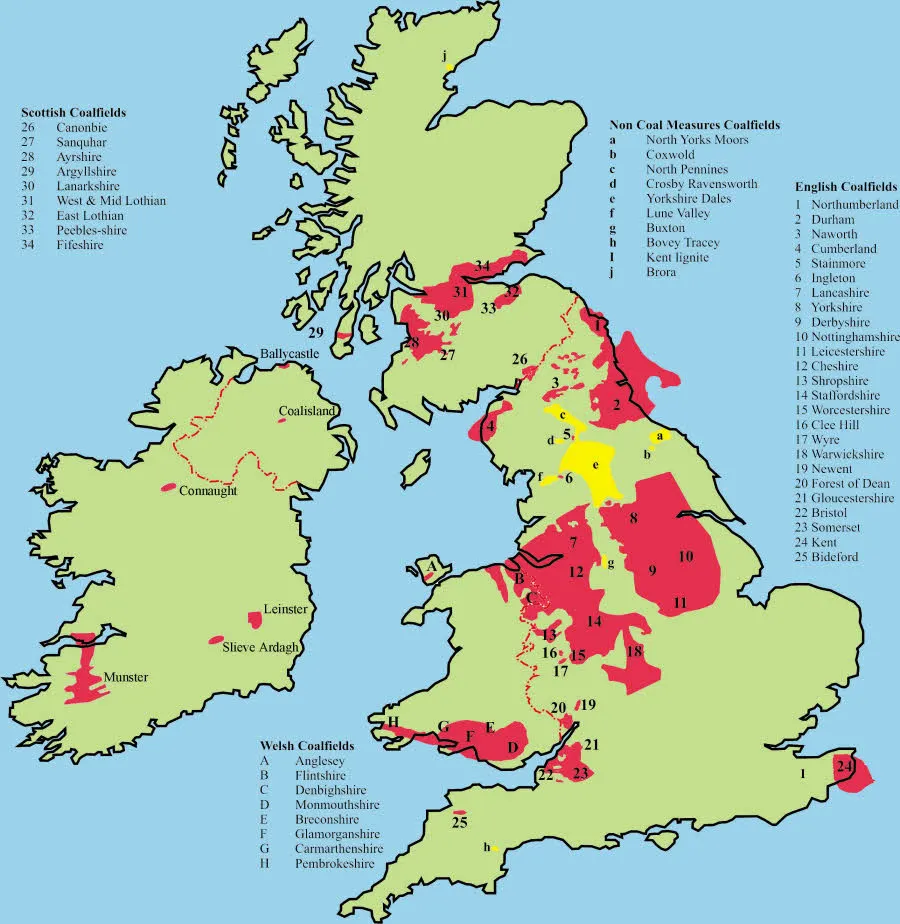
By the time German and Dutch coal was developed enough to compete, Britain had a century-long head start and had already built its institutions and industries around that advantage.
One economic historian (E. A. Wrigley) calculated that English coal production in 1800 yielded energy equivalent to 11 million acres of woodland.
Britain’s total land area was 32 million acres. The island was running on stored sunlight from a hundred million years of geological luck.
The steam engine was not the cause. It was the consequence. Britain invented it, refined it, and deployed it at scale because energy was cheap enough to make it worth building.
Other European nations had smart people. They didn’t have the energy economics to justify the investment. As one historian put it: had German coal been developed in the sixteenth century rather than the nineteenth, the industrial revolution might have been a Dutch-German achievement instead.
The industrial map of Britain was the map of the coalfields. Geography wasn’t just an advantage it was the deciding factor.
Next - oil rewrote the global order (example 2)
The twentieth century’s geopolitical architecture — wars, alliances, sanctions regimes, the positioning of aircraft carriers — was almost entirely downstream of oil.
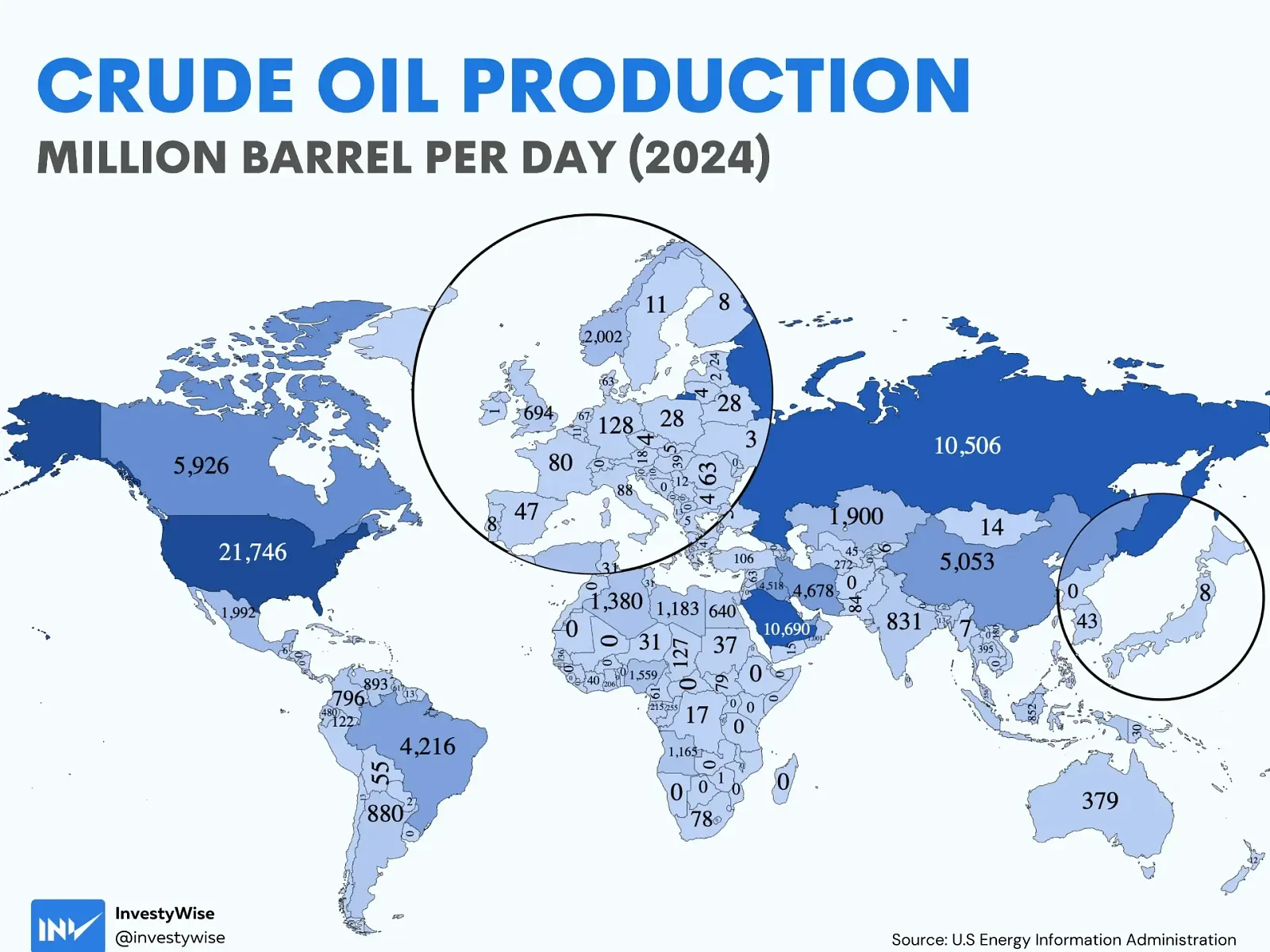
Countries that had it called the shots. Countries that didn’t spent their foreign policy trying to secure access to it.
The technology was beside the point. The internal combustion engine was invented. The question was who controlled the energy it ran on. Standard Oil, the Seven Sisters, OPEC, the petrodollar. All of it was an energy story wearing an economics costume.
The pattern is the same now. A general-purpose technology emerges. It requires a new form of energy at scale.
The nations that control that energy gain a structural advantage that compounds over decades. The ones that don’t pay the toll to access it from someone else.
How much energy will we need?
The IEA projects global data centre electricity demand doubling by 2030 — roughly Japan’s entire current consumption. That’s the conservative number. In the accelerated scenario it approaches five times today’s usage by 2035. AI-specific servers are the fastest-growing component, at around 30% annually.
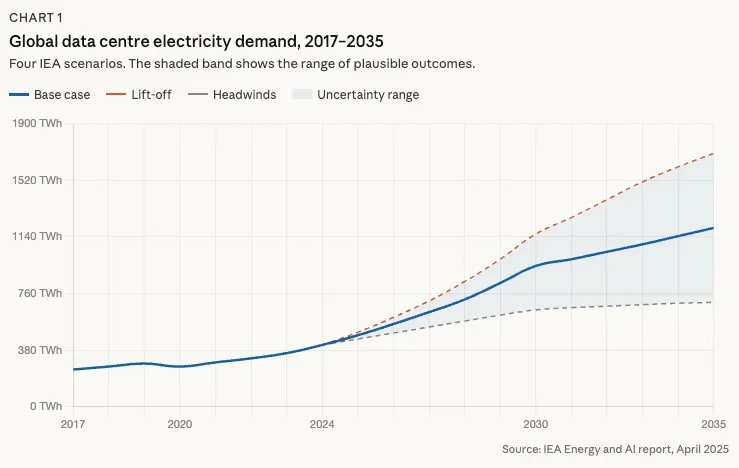
The IEA also warns that 20% of planned data centre projects could face grid connection delays. Not a hypothetical bottleneck. The Stargate UK story is what that looks like in practice.
By 2030, the US economy is on course to consume more electricity processing data than manufacturing all energy-intensive goods combined — aluminium, steel, chemicals, everything. Think about what that means for industrial policy.
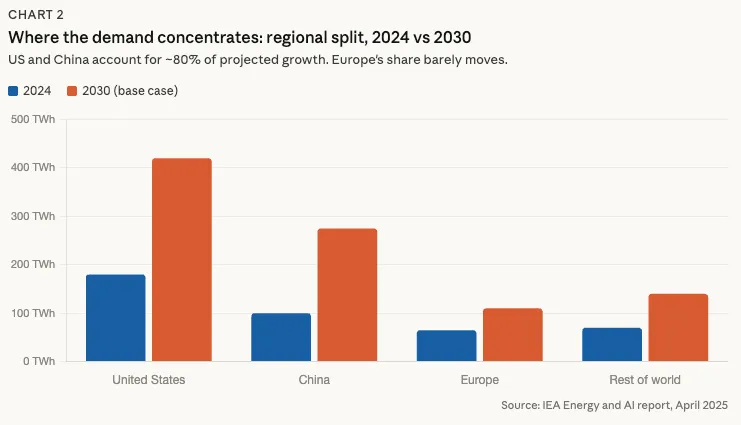
Europe’s bar barely moves. The US nearly triples. China more than doubles. Here is the “map of the coalfields” argument in bar chart form.
Then there’s water. Data centres generate extraordinary heat requiring cooling at scale. The average facility consumes around 300,000 gallons of water per day.
Some regions will have cheap electricity and discover they can’t build at scale because they don’t have the water rights. The places that win have both. Most places people are excited about right now have only one.
Geography matters again
The information economy spent thirty years making geography irrelevant. Talent could live anywhere. Companies ran distributed teams. The knowledge worker in Austin did the same job as the one in Amsterdam. Location became a lifestyle choice.
AI breaks that. A data centre cannot work remotely. It cannot locate itself near where talent wants to live, or in the city with the best restaurants, or wherever the founders went to university.
Physics says that data needs cheap, reliable power and enough water to stay cool. For the first time since the coal era, economic infrastructure has hard geographic constraints again.
The places that win this round are not the places that won the last one. Iceland, Norway, parts of Quebec and the American West — locations that looked like pleasant backwaters in the knowledge economy — are sitting on energy surpluses that now look strategically valuable.
The Middle East is already repositioning.
Countries that built wealth on hydrocarbon exports are looking at their energy infrastructure and asking: what else can we run on this? The answer, increasingly, is compute.
Countries that can’t generate abundant power domestically will rent access to compute from those who can. That’s the oil dependency dynamic, rebuilt for the twenty-first century.
Three very different regional positions
United States / Advantaged
Abundant natural gas, aggressive deregulation, energy sovereignty as explicit policy. Grid constraints are real and turbine backlogs run to 2029 — but the direction is clearly toward build.
China / It’s complicated
Adding more solar and wind than the rest of the world combined, while coal remains the baseload backbone. Jensen Huang called Chinese energy “basically free.” The cost advantage is real, but the energy mix creates political exposure.
UK / Europe / Exposed
Some of the highest industrial energy costs in the world. The continent risks being priced out of the infrastructure layer of the AI era entirely.
China’s position deserves a closer look. Beijing has 32 nuclear reactors under construction. The US has built two since 2014.
China’s solar manufacturing capacity exceeds 1,000 gigawatts; the US sits at 26 gigawatts. This is a calculated pivot away from oil import dependency toward domestic energy production of any kind. EVs, solar, nuclear: the common thread is energy that doesn’t need a shipping lane. China watched the twentieth century and drew the obvious conclusion.
Beijing frames data centre dominance as national security, not economics. Chinese policy documents describe control over data infrastructure as control over “new quality productive forces.” Xi has called AI China’s chance to “overtake on the curve.” The energy build-out is the prerequisite, not an afterthought.
From the USA’s perspective Trump’s angle opposing renewables is more strategically coherent than it looks. The easy read is fossil fuel donors. That’s probably part of it. But underneath sits a harder geopolitical logic. China controls over 70% of global solar, wind and battery manufacturing. A world that rapidly transitions to renewables is one where China’s manufacturing dominance converts directly into energy dominance over every country buying its panels and batteries.
America has a massive fossil fuel advantage. Marco Rubio literally told Munich that the global shift to renewables is a “source of leverage against Washington.” The administration is actively pressuring allies to sign long-term LNG contracts, partly to lock them into fossil fuel dependency and away from a clean-tech supply chain that China dominates.
Whether that holds against market physics is another question entirely. Solar is already the cheapest form of new electricity generation almost everywhere. But the intent is strategic, not just transactional.
Third-order effects: the next gold rush
When a resource becomes strategically scarce, capital reorganises around it. It happened with coal, with oil, with shipping lanes, with semiconductor fabs. First the constraint becomes visible. Then the obvious plays get crowded. Then the real money moves into the infrastructure that makes the resource usable. We’re somewhere between step one and step two.
Energy infrastructure in politically stable jurisdictions is being repriced as strategic necessity rather than boring yield. A Norwegian hydroelectric operator or a Texas grid company looked very different five years ago. That repricing has further to run.
Nuclear surprises people. The politics have been terrible for decades — Chernobyl, Three Mile Island, cost overruns, the general aura of catastrophe. But data centres need power at 3am in December, not just on sunny afternoons. Intermittency is fine for households. It’s a serious problem for compute infrastructure that runs without pause.
Small modular reactors — dedicated, co-located, purpose-built — are the solution the industry is converging on.
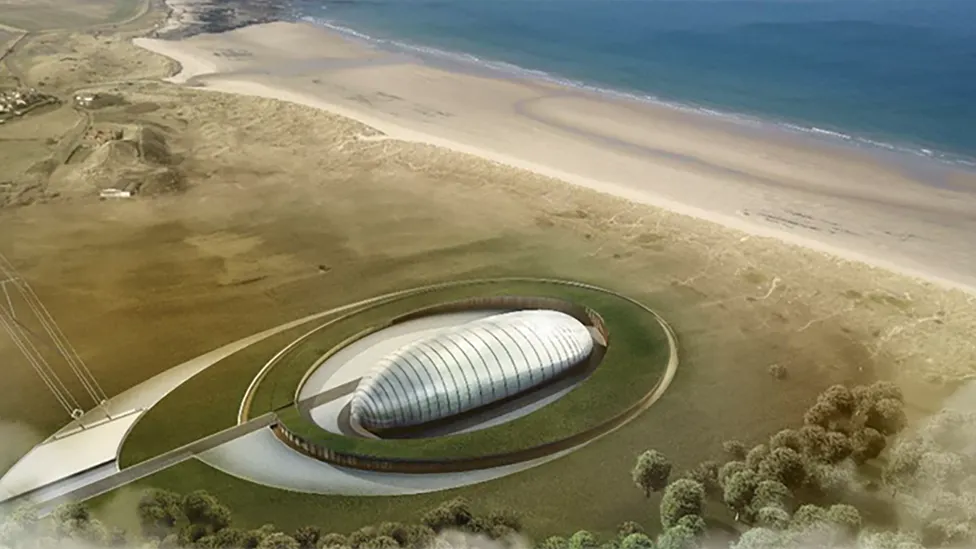
Technology companies have announced plans to finance more than 20 gigawatts of SMR capacity. The first units come online around 2030. This stopped being speculative some time ago.
Further out, the consequences get stranger. Land near power infrastructure — industrial parcels adjacent to substations, transmission corridors, generation facilities — is quietly becoming valuable. By conventional metrics it’s worthless: no foot traffic, no amenity, no desirability. By the metrics that matter when a hyperscaler needs to expand in a power-constrained market, it’s not. The colliery owners of the eighteenth century didn’t look like savvy real estate investors at the time either.
Transmission is the chokepoint people overlook. You can build generation. Getting power reliably from where it’s generated to where data centres need it is a different, slower, more politically fraught problem — planning permission, grid upgrade cycles, right-of-way disputes.
The IEA’s warning that 20% of planned data centre projects face grid connection delays is a transmission problem as much as a generation one. Companies that move electrons efficiently — grid technology, power electronics, transmission infrastructure — are building something close to a natural monopoly in the pipes of the AI economy.
Cooling is the final hidden constraint. Liquid cooling, immersion cooling, heat dissipation that works in water-scarce regions: unglamorous businesses. Neither was sewage engineering in Victorian London. Essential, though.
The second bounce
The first bounce of the AI era is obvious and largely priced: model companies, chip designers, cloud platforms. Everyone sees that trade.
The second bounce is energy. Not in the abstract ESG sense — in the concrete, structural sense of who hosts the intelligence layer of the economy.
Cheap dispatchable electrons are the new oil fields.
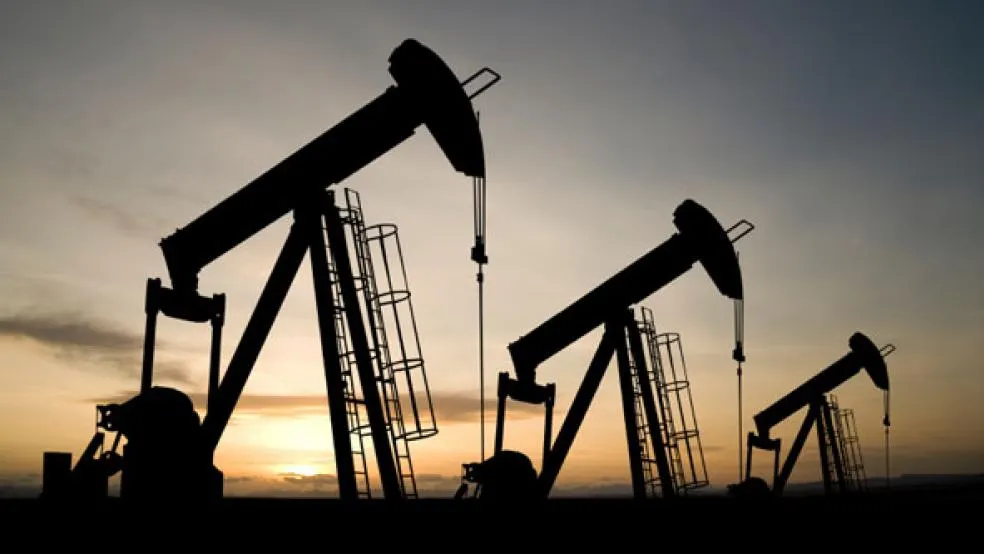
The places that have them will build the data centres. The data centres concentrate the economic activity. The activity compounds over decades, exactly as it did around the coalfields of northern England and the oilfields of Texas and the Gulf.
Utilities, transmission infrastructure, nuclear operators, water rights, cooling technology, land next to substations — none of it is exciting. It wasn’t exciting in 1750 when someone bought into a Newcastle colliery either. But that’s where structural advantage accumulates.
OpenAI told the UK government that in plain English this morning. Most people will file it under “regulatory friction” and move on.
But the big story is the world needs more electrons at the right price, and we will reshape the world to get them.
Coda
This is Part 4 in a series exploring second-order effects of AI that markets aren’t pricing in. Read Part 1 here on the core thesis - The “Second Bounce of the Ball”. Read Part 2 here on capital vs labour. Read Part 3 here on the changing tax base.
