By Matt Law
RWAs and the Great Unbundling
The internet spent decades unbundling media. Now it comes for $500 trillion of global assets. BlackRock's bet and JPMorgan's tokenization platform are the opening moves in finance's Great Unbundling.
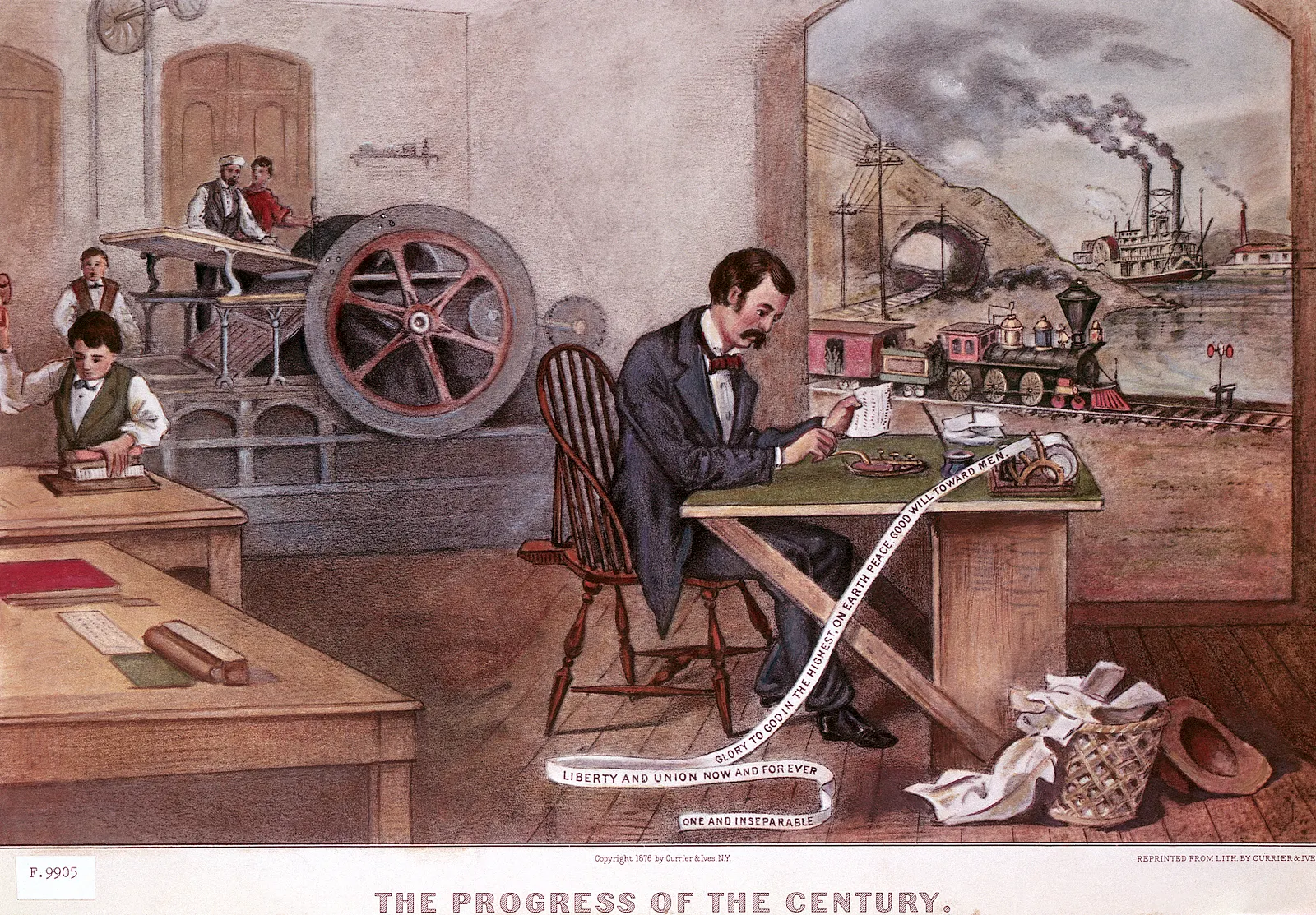
There are only two ways to make money
Bundling and Unbundling
Think about why the securities markets have been able to make so much money over time, and create so much value for the world. They have been “bundling” - taking disparate and disconnected elements and packaging them together inside a single “stack” of technology, business agreements, regulation and communications.
For a long time, this has created connections where there were none. Aggregating together disparate elements so that you can create value is one of Jim Barksdale of Netscape’s “ways to make money”
There are only two ways to make money in business: One is to bundle; the other is unbundle.
However, over time these structures tend to crystallise, with legal, tech and regulatory hurdles freezing the value chain in place to support incumbent business models, while a wall of pressure slowly builds up from new opportunities and potential disruption.
Eventually that wall breaks, and new approaches enter that market, and they tend to unbundle what was previously bundled to create value in new ways. And then slowly, the cycle starts again.
But hold up - what the internet has been doing since the 1970s (and communications technology for longer than that has been part of a trend that you could call The Great Unbundling.
I would argue that the long term distinguishing features of the internet = Disintermediation and Decentralisation.
What does that mean - disintermediation is the removal of agents and middlemen from business transactions, and decentralisation is the movement of power to the edges of a network rather than controlled strongly from the centre. Controversial historian Niall Ferguson writes eloquently about this in his book “The Square and the Tower”
For the first 10+ years we had digital assets, but now we are seeing the start of the blockchain’s contribution to the “digitisation of everything else”. So real world assets are put very broadly - the means by which off-chain or “real-world” items are represented in decentralised networks
The $24 Billion Foundation
The real-world asset tokenisation market has quietly grown 380% in three years to reach $24 billion by mid-2024. But this headline figure hides the bigger picture. When you include stablecoins - essentially tokenised dollars - the total sits at over $200 billion. BlackRock’s $2.9 billion BUIDL fund became the world’s largest tokenised fund within weeks. JPMorgan launched its Tokenised Collateral Network. Visa deployed its Tokenised Asset Platform. Robinhood is partnering with Arbitrum for tokenised securities. Last week Stripe announced payments blockchain Tempo
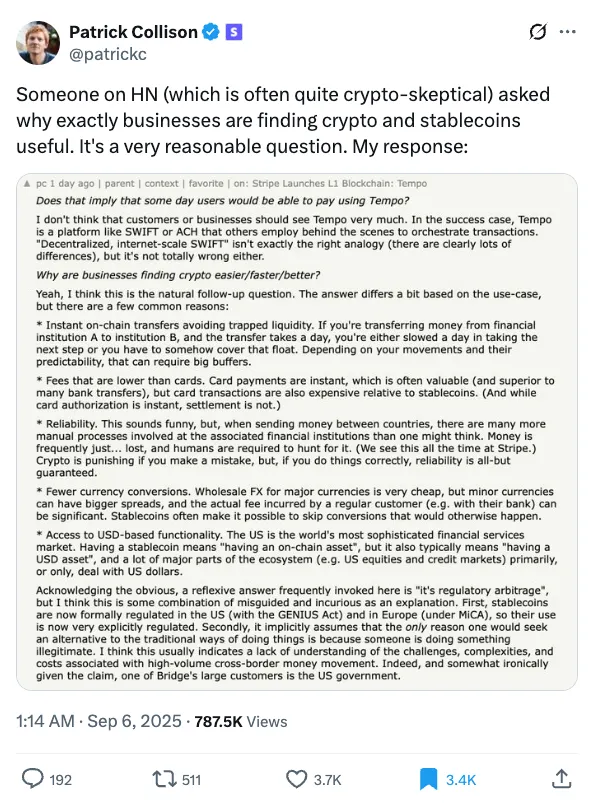
https://x.com/patrickc/status/1964119986227806502
Private credit has surged to $8 billion. Real estate tokenisation is projected to capture nearly one-third of the entire market by 2030. Major institutions from Franklin Templeton to Apollo are committing serious resources to tokenisation infrastructure.
Market projections vary wildly - from McKinsey’s $2 trillion estimate to Standard Chartered’s $30 trillion by 2034. But every forecast points in the same direction: we’re witnessing what could become the largest capital migration in financial history.
With huge brands like these jumping in we are miles beyond the PR “partnership” or proofs of concept from yesteryear. Why?
Fixing a Burning Platform

Traditional finance operates on legacy infrastructure burdened with what are now clear to see are inefficiencies that cost billions annually. Right now the system relies on sequential processes managed by multiple intermediaries, each validating and confirming another party’s actions. This concentration of credit, market, and liquidity risks onto clearing agencies creates systemic vulnerabilities that were starkly exposed during the 2008 financial crisis.
Settlement takes two business days, creating counterparty risk windows where either party could default. The DTCC estimates that just a 2% global failure rate results in costs and losses of up to $3 billion. Billions more sit tied up as collateral against settlement risk.
If it is the only music playing then you have to dance, but DeFi has showed that there is another song you can sing. Revolutions are started by idealists, but finished by pragmatists…
RWAs offer atomic settlement, elimination of counterparty risk during settlement, and programmable compliance. This is infrastructure replacement that solves problems plaguing finance for decades.
So slowly, then suddenly, we are witnessing a Great Unbundling of financial assets - the ability to separate, price, and trade individual rights and cash flows that were previously locked together
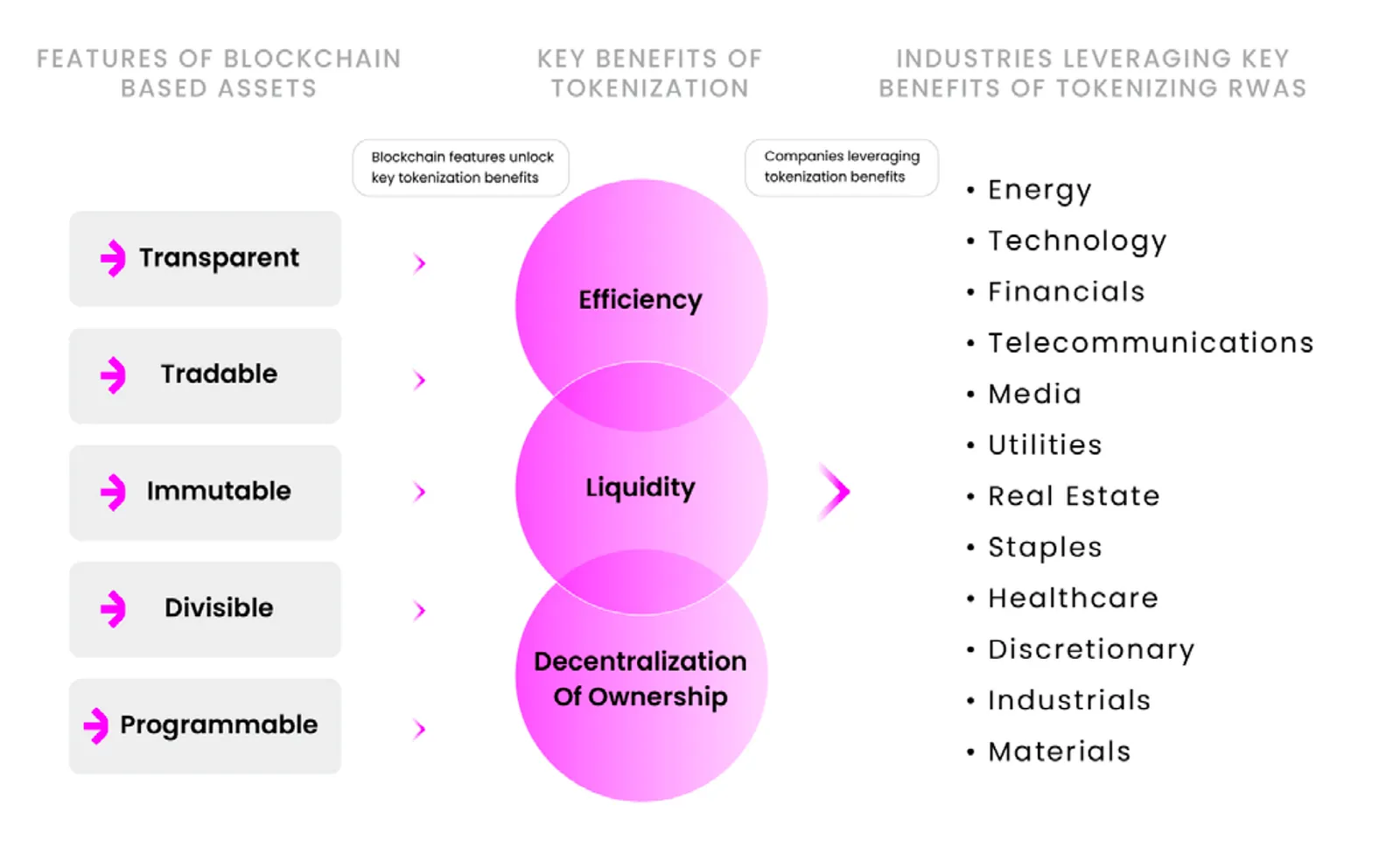
According to our team at Outlier - Real World Asset tokenisation delivers value through three mechanisms: efficiency gains, liquidity creation, and decentralised ownership.
Beyond The Hype of Real World Assets: Outlier Ventures
Efficiency: Streamlining Asset Management
Blockchain’s transparency, immutability, and programmability streamline asset management across entire value chains.
The consortium challenge remains the biggest barrier. Most efficiency gains require multiple parties to adopt shared infrastructure, creating a chicken-and-egg adoption problem. Companies that aren’t fully economically aligned struggle to collaborate and share information about tokenised RWAs.
Energy, technology, telecommunications, and industrial sectors are seeing immediate benefits from transparency and automated processes. The value proposition is: improved performance using “the least amount of inputs to achieve the highest amount of output.”
Financial assets are leading because professionals already understand efficiency, liquidity, and fractional ownership concepts. They’re already largely intangible and digitally represented, with massive existing value pools representing two-thirds of global assets.
Liquidity: Creating Markets Where None Existed
Blockchain’s divisibility and tradability features create liquid markets for previously illiquid assets through two distinct mechanisms.
Tradability brings over-the-counter markets on-chain. Asset segregation breaks assets into tradeable components. When you can tokenise the yield on an asset separately from the principal, or the digital rights separately from the physical property, you create new asset classes and unlock hidden value. The sum of parts can exceed the whole. These are new financial primitives born in DeFi but now spilling over into traditional markets.
The liquidity challenge centres on fragmentation. Lack of standardisation across tokenisation practices and marketplaces leads to liquidity splintering across multiple trading venues, making it difficult and expensive to trade assets efficiently.
Ownership: Democratising Access
Blockchain’s divisibility and programmability enable new ownership models for assets that traditionally required massive capital commitments. This represents the most ambitious transformation - moving beyond improving existing processes to creating entirely new economic structures.
Decentralised Physical Infrastructure (DePIN) allows telecommunications networks owned by token holders, energy storage and generation systems distributed across participants, compute and data storage networks collectively managed, and transport and logistics infrastructure coordinated through smart contracts.
Machine-as-a-Service models enable industrial equipment owned collectively but managed by specialists. Distributed ownership reduces barriers to entry while smart contracts automate maintenance and revenue sharing.
The ownership challenge involves regulatory frameworks for distributed ownership that are still developing, creating legal uncertainty around bearer ownership models. Token embedded rules need regulation to become enforceable.
Finance leads the way in RWA asset unbundling
Finance leads because the fit is obvious: financial assets are already digital (no oracle headaches), represent 65% of global assets, and finance professionals already understand fractional ownership and liquidity.
Gemini security tokens overview (2021)
We talked about “security tokens” nearly 10 years ago, but now the technology, and the regulation has caught up. The barriers are lower here than anywhere else, but they are the bellwether for a broader transformation
Three convergences are clearing the path for RWA tokenisation adoption.
Institutional adoption brings major financial institutions launching tokenisation pilots. DTCC, Clearstream, and Euroclear provide the asset pools and regulatory relationships needed for scale. These entities control the pace of adoption for financial asset tokenisation - the largest component of the global economy.
Technology maturation means blockchain infrastructure has reached enterprise-grade reliability. Improved scalability, security, and cross-chain interoperability complement mature developer tooling and tokenisation standards.
Regulatory clarity: Traditional markets are setup such that various intermediaries are required. We need to work in that world, so regulation comes into that. There are some positive signs from regulators emerging through progressive frameworks like MiCA and the UK Electronic Trade Documents Act providing legal certainty. CBDCs and stablecoins solve settlement mechanisms that previously created gaps in on-chain transaction processing.
Unbundling and its second order consequences: a “computable economy”?
Each benefit targets different industries and solves different problems, but together they point toward what crypto-economic researchers Justin Banon and Jason Potts describe as a “computable economy” where all assets become programmable inputs to smart contract systems.
These three benefit pathways - efficiency, liquidity, and decentralised ownership - an economic paradigm where digitally native web3 technologies facilitate development of a system that enables significant increases in economic complexity and wealth.
The technology enables “computable capital” and “programmable commerce” - potentially creating what might be called a “turing-complete economy”.
- Asset segregation represents the killer feature that current market estimates miss entirely.
- The ability to break assets into separately tradeable components creates new value.
- Price discovery for previously illiquid assets increases their value, while segregation allows separate liquid markets for asset elements, leading to further price discovery.
- The evolution from “dumb tokens” - simple asset representations - to “smart tokens” with embedded programmable logic marks the transition from digitisation to true programmable commerce.
- Token programmability allows automatically executable actions embedded in smart contract code, enabling easy and low-cost reengineering of cash flows, investments and asset transfers.
This represents the implementation phase of a Great Unbundling of financial infrastructure. For centuries, assets came as indivisible packages - you bought the whole building, the entire company, the complete bond. Tokenisation decomposes these packages into programmable components that can be priced, traded, and owned independently.
The coordination technology “civilisation upgrade”
Asset segregation wasn’t possible before because traditional finance operates on coordination technology that hasn’t fundamentally changed for centuries. The system relies on human-based mechanisms - language, legal frameworks, trust relationships - to manage ownership and transfers. Breaking assets into separately tradeable components requires automated, programmable enforcement of complex ownership structures that humans simply can’t coordinate at scale.
Blockchain solves what economists call the coordination layer problem. It enables trusted, automated institutional mechanisms that can track fractional ownership across multiple parties without requiring everyone to trust each other first. The technology provides machine-to-machine coordination at speeds and scales impossible with paper-based or even traditional digital systems. Asset segregation only works if all participants adopt the same standards simultaneously - a network effects problem that blockchain’s shared infrastructure finally makes possible.
So which industries will build the demand-side infrastructure to capture these benefits first? The critical transition occurs when institutional computation extends from on-chain assets to off-chain real world assets. This is something Boson Protocol has been working on for a number of years and solutions that focus on truly decentralized or “open” technologies, will in my view win in the end.
The infrastructure being built today - from BlackRock’s BUIDL fund to JPMorgan’s Tokenised Collateral Network - enables the programmable decomposition of value itself. We’re witnessing the construction of rails for what might become a multi- trillion transformation in how assets get structured, owned, and traded.
For more on this, read my previous article
Related: From firms to networks: How coordination technology will reorganise everything
Source material and references:
The Square and the Tower - Niall Ferguson
Platform Revolution - Geoffrey Parker, Marshall Alstyne, Sangeet Choudary
The Technology Trap - Carl Frey
The Rise of the Network Society: Manuel Castells
The Great Unbundling: Ben Thompson
Beyond The Hype of Real World Assets: Outlier Ventures
Digital Institutions Create Wealth by Increasing Economic Computational Complexity: Justin Banon and Jason Potts